Using Webb, Canadian Astronomers explains the Milky Way Turbulent Past

The Milky Way has long and fascinating history that extends back to early Universe ca 13.61 billion years before.

It has evolve and merged with other galaxies to become the galaxy we see today.

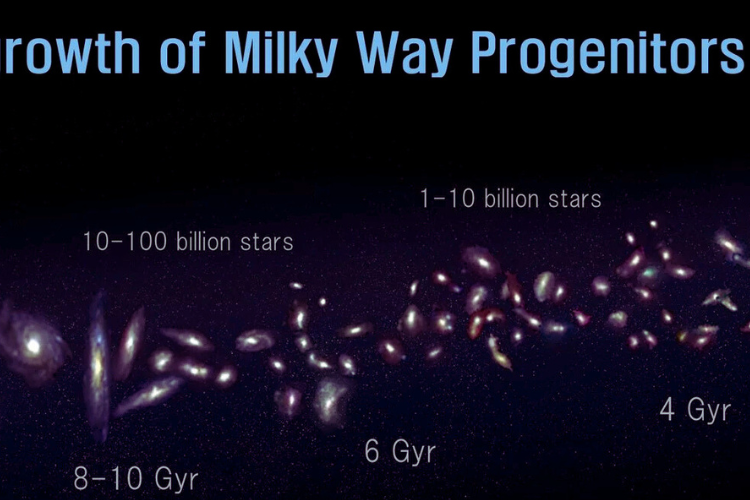
In latest study a team of Canadian astronomers has created the detailed reconstruction of how the Milky Way evolved from its earliest phase to current phase.

Using data provided by the James Webb Space Telescope JWST the team examined 877 galaxies whose masses properties closely match what astronomers expect the Milky Way looked like over time.

James Webb Telescope

Astrophysics

The galaxies in this survey spanned range of cosmic time from when the Universe was1.5 to 10 billion years old.

By observing more galaxies that existed when the Universe was younger the team created a visual timeline of Milky Way evolution.

To their surprise they found that Milky Way had remarkably turbulent youth before setting into stable and structure adult we are familiar with today.

In accordance with the Hubble Sequence astronomers classify galaxies into three groups based on their shapes spiral, elliptical and barred spiral.

Elliptical galaxies represent early phase of evolution and have structure or interstellar dust and gas.

Lenticulars which represent intermediate phase in evolution consist of bright central bulge surrounded by extended disk, spiral noted for their pinwheel form,  consist of central bulge and flattened disk with stars shaping spiral structure.

Outside of these three morphologies are famous as irregular galaxies.

The study was led by Dr Vivian Tan who completed her PhD at York University under supervision of Prof. Adam Muzzin.

James Webb Telescope

Astrophysics

They were joined by researchers from Dunlap Institute of Astronomy and Astrophysics, the SMU Institute for Computational Astrophysics, the Kapteyn Astronomical Institute, the Columbia Astrophysics Laboratory, the Space Telescope Science Institute.

The galaxies in sample are dated to crucial epoch when galaxies went from being smaller, masses of stars to stable disk galaxies that are common today.

For their study, the team combined high resolution imaging from the JWST and venerable Hubble to create census of 877 early galaxies.

The JWST observation were obtained as part of the Canadian NIRISS Unbiased Cluster Survey CANUCS.

This Canadian observing program uses data from Webb Near Infrared Imager and Slitless Spectrograph NIRISS.

This instrument was built by Canadian Space Agency CSA in partnership with the Universite de Montreal the National Research Council Herzberg Centre for Astronomy and Astrophysics, and Honeywell Robotics, CANUCS uses data from the NIRISS instrument to observe five galaxy clusters which are natural gravitational lenses that allow astronomers to observe fainter more galaxies.

Mixed with visible light observations by Hubble the team created resolved stellar mass and star formation SFR maps for each galaxy observed.

These maps showed where existing stars were located.

New stars were forming during different phases of galaxies evolution.

The results showed a clear pattern across entire sample showing that Milky Way Galaxy twins grew from the inside out between 3 and 4 billion years after Big Bang.

Canada Web Space News

Galaxy

They start with dense central region and mass in their outer regions through mergers and new star formation gradually forming extended spiral structures.

Tan and her colleagues then ran state of the art computer simulations that track the evolution of Milky Way like galaxies which confirmed inside out growth model they observed.

The simulation failed to reproduce the high central nature of early galaxies in some cases and failed to predict how mass accumulated in outer regions.

These results provide constrains for theoretical models of evolution and mechanism involved including feedback merger rates.

Astronomers have been modeling the formation of the Milky Way and spiral galaxies for decades said Tan.

It is amazing that with the JWST we can test their models and map out how Milky Way progenitors grow with Universe itself.

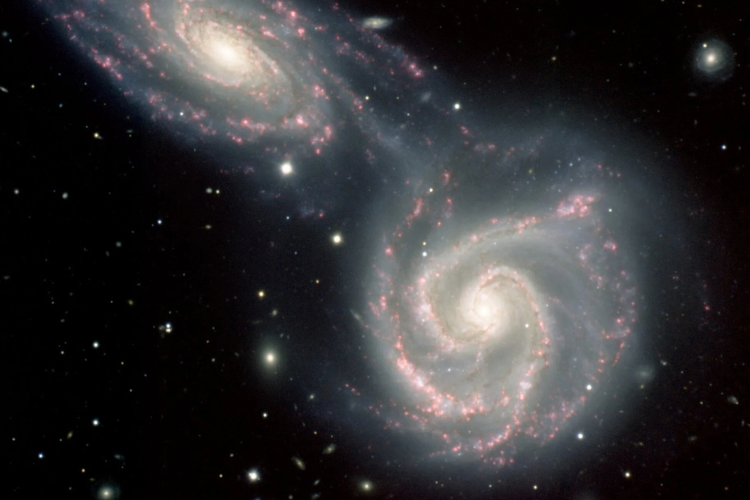
A major takeaway from this study is pointed that Milky Way early history was more chaotic than previously expected.

It appear galaxies in early time were constantly celliding and  accreting material triggering intense bursts so star formation.

Canada Web Space News

Galaxy

This is evidence by highly disturbed shapes and asymmetric features they observed.

Milky Way twins appear much more stable in later cosmological times characterized by smoother structures and more distributed star formation.

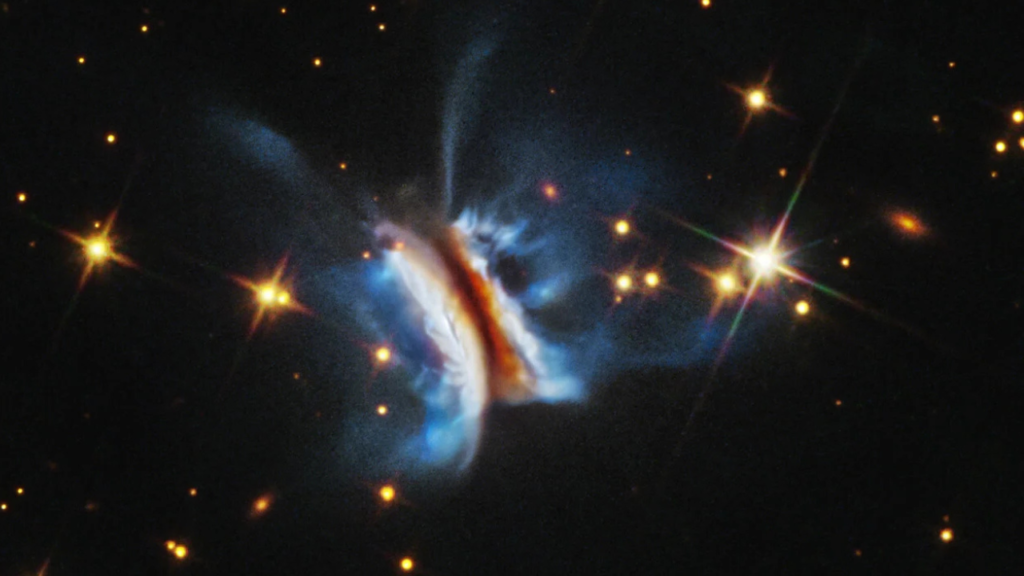
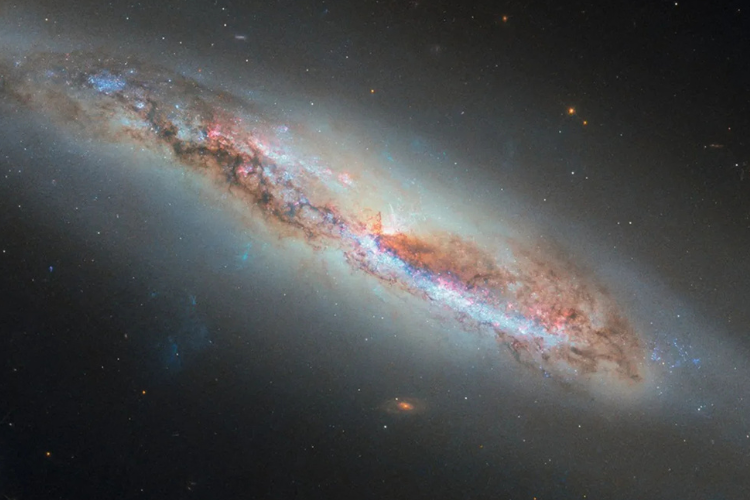
Hubble partial view Galactic Gas Making a Getaway

A sideways spiral galaxy shines in this NASA/ESA Hubble Space Telescope photos.

Located about 60 million light years away in constellation virgo.

NGC 4388 is resident of the Virgo galaxy cluster.

This huge cluster of galaxies consist of more than a thousand members and is nearest large galaxy cluster to the Milky Way.

NGC 4388 appears to tilt at extreme angle relative to our point of view giving us a near edge on prospect of galaxy.

This perspective reveals a curious feature this was not visible in Hubble image of this galaxy released in 2016 a plume of gas from galaxy nucleus here seen billowing out from galaxy disk toward lower right corner of the photos.

Hubble Telescope

Nasa images

The answer lies in vast stretches of space that separate the galaxies of the Virgo cluster.

The space between galaxies appears empty the space is occupied by hot wisps of gas called the intracluster medium.

As NGC 4388 moves within Virgo cluster it moves through the intracluster medium.

Pressure from hot intracluster gas whisks away gas from within NGC 4388 disk causing it to trail behind as NGC 4388 moves.

The source of ionizing energy that causes this gas cloud to glow is more uncertain.

Researchers suspect that some of energy comes from center of the galaxy where supermassive black hole spin gas around it into superheated disk.

Hubble Telescope

Nasa images

The blazing radiation from disk might ionize the gas closest to galaxy while shock waves might responsible for ionizing filaments of gas farther out.


The sticky problem of Lunar Dust Get a mathematical solution

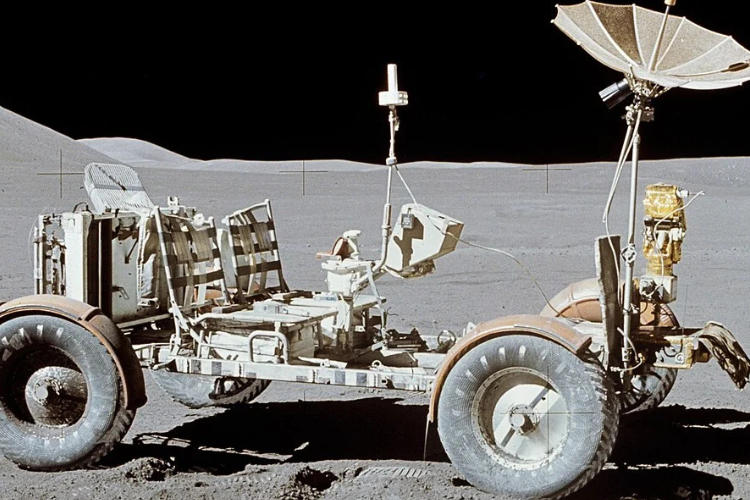
Apollo astronauts discovered unexpected enemy on the Moon.

Fine dust, start by their movements and attracted by static electricity coated everything.

It found its way through seals, scratched visors and clung to suits despite brushing.

Eugene Cernan described it one of most aggravating aspects of lunar operations.

Over five decades later humanity prepares to return to the Moon with sophisticated equipment solving the lunar dust problem has become critical.

Lunar Rover

Appolo

Researchers from the Beijing Institute of Technology, China Academy of Space Technology and Chinese Academy of Sciences have developed a detail theoretical model that explain how charged dust particles interact with spacecraft surfaces during low velocity collisions.

The challenge starts with Moon harsh environment.

On the dayside intense solar ultraviolet and X ray radiation strips electrons from both spacecraft and lunar surface leaving them positively charged.

This creates photoelectron sheath hovering above ground.

On the nightside spacecraft and regolith instead collect electrons from surrounding plasma becoming negative charged and forming what is called a Debye sheath.

The solar wind adds other layer of complexity continuously bathing in charged particles.

Within this electrically active environment dust particles themselves become charged and experience three distinct electrostatic forces as they approach a spacecraft.

Lunar Rover

Appolo

The electric field force acts on particle surface charge pulling it toward or pushing it away from vehicle depending on whether their charges are  opposite or the same.

The dielectrophoretic forces arises because the dust particle distort the non uniform electric field around it creating attraction toward regions of stronger field regardless of particle charge.

The image force emerges when the approaching charged particle creates opposite charge in spacecraft conductive surface similar to how balloon sticks to wall creating additional attractive pull.

The researches model treats these electrostatic interactions in mathematical detail but recognizes that other forces dominate once contact starts.

When dust grain actually strikes a spacecraft coating adhesive van der Waals forces between molecules at surface become dominant for the slow velocity impacts common during lunar operations.

The collision itself unfolds in three stages. First comes adhesive elastic loading, where the particle compresses against the coating while attractive forces between surfaces grow.

Lunar Rover

Appolo

If impact is energetic enough the coating starts to deform, dissipating energy as material yields.

During unloading stage the particle either bounces away or remains stuck depending on whether the collision velocity falls within critical range.

The model announces several practical.

A dielectric coating with high thickness and low permittivity can reduce the electrostatic attraction between charged dust and spacecraft.

The particle surface charge density matter over spacecraft electrical potential in determining strength of electrostatic forces.

For particles carrying typical charge densities below o.1 milliColumbs per square meter.

The adhesive Van der Waals force overwhelms electrostatic effects during actual contact.

Most useful for mission planners the research shows that coating made from low surface energy material with rough textures can reduce dust adhesion.

Larger particles tend to have higher coefficients of restitution meaning they are more likely to bounce away rather than stick.

There exist a critical velocity range for negative charge particles where adhesion occurs. impacts slower or faster than this window permit particles to escape.

This latest mode can predict dust accumulation pattern guide selection of surface coating and help optimize dust removal systems.

Mission to moon grow more ambitious and long duration solving sticky problem of lunar dust moves from annoyance to operational necessity.

Lunar Rover

Appolo

Source

https://www.eurekalert.org/news-releases/1110112

https://www.universetoday.com/articles/the-sticky-problem-of-lunar-dust-gets-a-mathematical-solution